Teaching Agents to Choose at Scale - IBM
Evals & Agent Tooling
Systems & Standards
overview
IBM wanted a world where ChatGPT, Claude, or any AI agent could run entire IBM workflows
When I joined, many teams had built MCP servers with hundreds of tools, and any agent accessing them struggled to pick the right one. An agent that picked the wrong tool wouldn't even know it had, and would pass the wrong data to a real user. That damaged trust in the platforms and in the agents people used every day.
I created an AI agent, and defined governance standards for all of IBM's MCP servers
The agent worked right in the developer's IDE, letting them quickly write test cases and eval sets and rewrite failing tools to improve tool-call accuracy for frontier models.
39.8% → 80.5%
Tool-call accuracy on a 400-tool test server after rewriting tool descriptions to a new standard.
+73%
Tool-call accuracy increase across 5 development teams in a private beta.
50 director-level PMs
Presented to, proposing how IBM should shape MCP products and strategy.
the brief
On my first day at IBM, I expected to be placed on a team with a defined problem in a familiar design team

“Focus on MCP...” I had no team, and the design organization didn't yet understand why MCP was an issue
By this point the MCP protocol had been out for two years and was standard for every agent. What could be the problem?
talking to the builders
Things worked on small servers, then fell apart as they grew
I interviewed 8 developers, 3 PMs, and 2 designers across 8 teams building MCP servers. Their problems differed in the details, but I noticed a pattern based on server size.
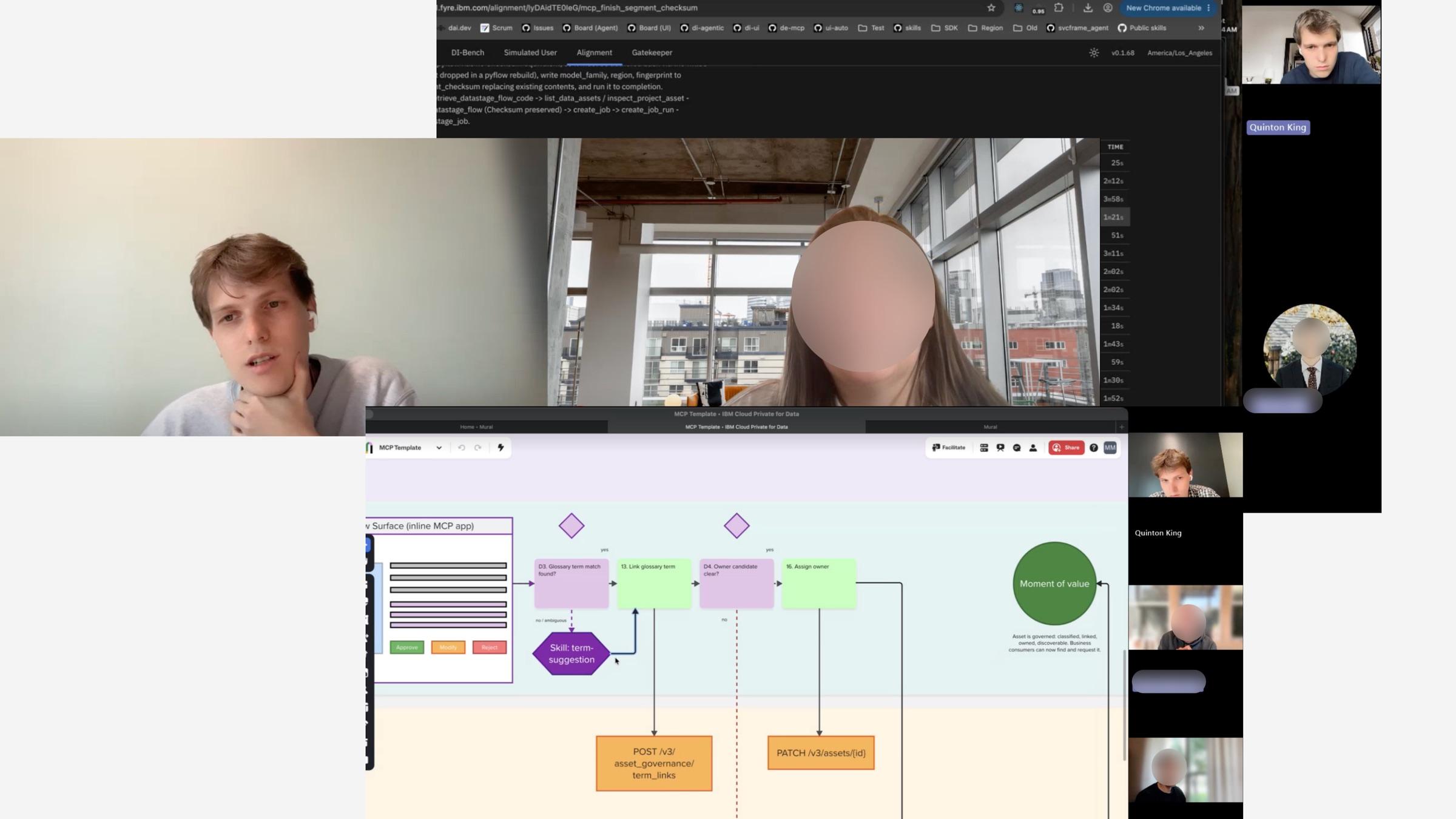
Small servers with few tools worked very well. As those servers scaled, users raised more complaints, even about workflows that had previously worked flawlessly.
the scale problem
Five tools is easy. IBM was exposing agents to hundreds.
When an agent has five or ten tools, it usually picks the correct one. The options are few, and their names and descriptions are distinct.
the root cause
Many tools were shaped and named alike
When an agent is exposed to hundreds of tools, the name and description are the only things the model understands about each one. When those look alike, the model can only guess.
get_reportRetrieves report data for a given metric over a time period.
fetch_reportFetches a report with data for the selected metrics and period.
report_queryQueries report data by metric, grouping, and time period.
defining good
Building my own MCP server
To measure the problem, I built a test server with 400 copies of real IBM tools and an eval set to define what “good” looked like.
Human-labeled ground truth
Truthfully, I bribed a bunch of interns with free pizza to create a human-labeled dataset. Each query we wrote had one correct tool call.
Frontier models take the test
I ran the eval set against frontier models on the test server to measure tool-call accuracy across IBM's servers.
the baseline
Far below anything shippable
compounding errors
That 40% negatively compounds in real IBM workflows & hurts users’ trust
The failure is invisible
A wrong tool throws no error. The agent doesn’t hallucinate, but it returns the wrong data.
Errors compound
Real requests take several tool calls. At 40% per call, a three-step task completes correctly about 6% of the time.
Users stop trusting the agent
When more than half the answers are wrong, people double-check everything, and the agent no longer benefits them.
server updates
Rewriting descriptions doubled accuracy
To test changes quickly, I built agent skills for my coding agent. The description was the strongest lever.
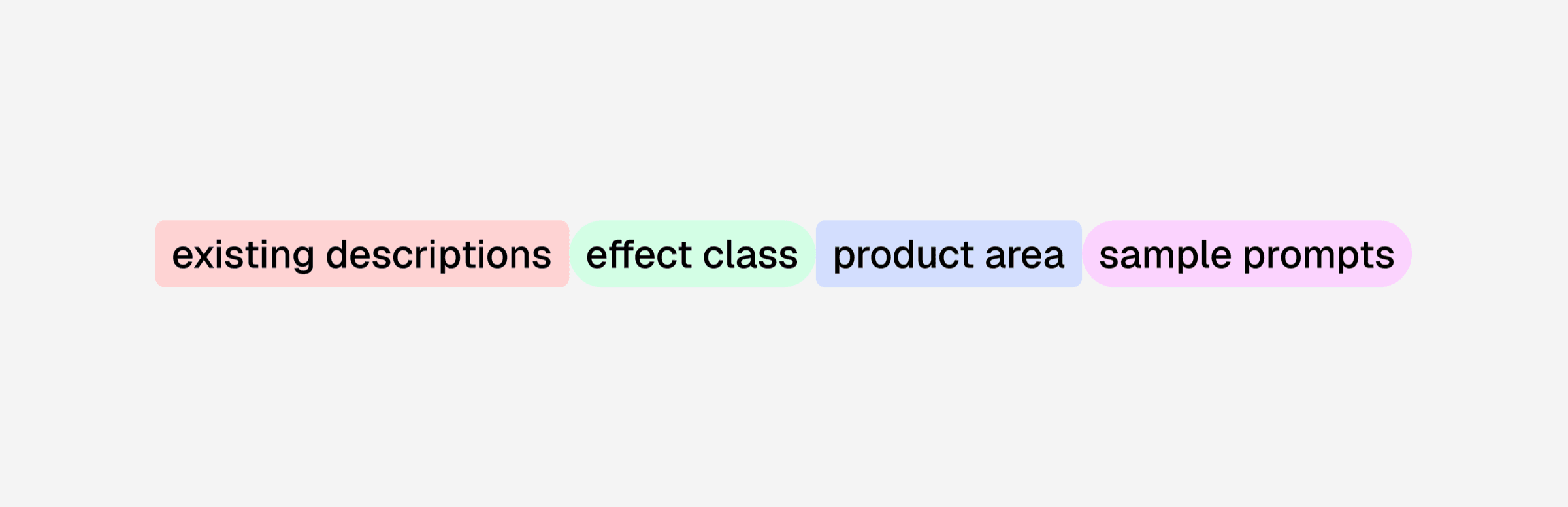
Each rewritten description followed a new format: what the tool does, its effect class, sample prompts that should call it (held out from the eval), and the product it serves.
scaling
How do we scale this to 80 teams at IBM?
VP-level mandates had tried to enforce standards before. Friction was too high for teams with servers already published, and the mandates were never enforced.
Every team had its own informal rules, and none of them talked to each other. With no shared standard and no shared way to measure, each team was solving the same problem alone, usually by brute force.
the agent
An agent to manage implementation
I had already built a set of skills for this exact job; they were how I created the tests for my own evals. I packaged them into an agent that takes a team's MCP server through a loop.
Input
A team's MCP server.
Audit
create_eval builds an eval set of natural-language queries for the server's tools.
Test
A subagent with clean context runs the eval set, then passes results back to the main agent for grading.
Rewrite
Tools that fail are rewritten to the standard, and the loop runs again.
This agent was much better at helping engineers adopt the standard, but it was grading its own homework.
The second iteration sends grading to a model from a different provider, so the grader isn't biased toward its own outputs.
results
Shipped to five teams in a private beta
Five MCP development teams volunteered for the private beta.
I presented the findings to 50 director-level PMs, with a proposal for how IBM should shape MCP products and strategy across the Data & AI division.